
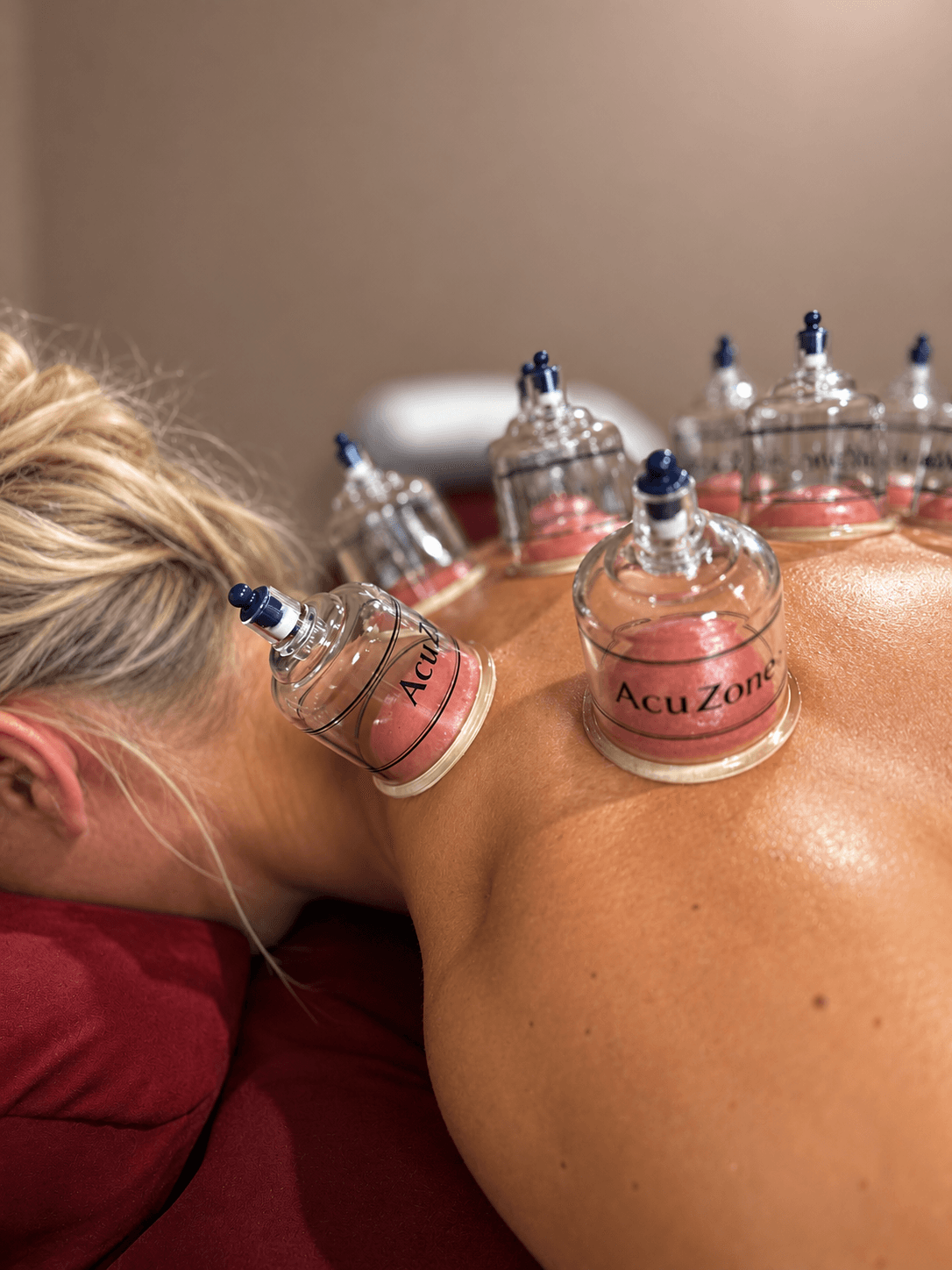
Silicone vs. glass, the truth about those circular marks, and how our therapists layer cupping into a session to reach fascia that a hand can’t.
Cupping, in plain English
Cupping is one of the oldest bodywork techniques still in continuous use — you’ll find records of it in ancient Egypt, China, and Greece. What’s changed is our understanding of why it works. Rather than mystical energy flow, modern practitioners think about cupping in terms of fascia: the connective tissue layer that wraps every muscle and can bind down after injury, poor posture, or repetitive strain.
Where a massage stroke pushes tissue down and slides across it, a cup lifts tissue up. That decompression is exactly what tight fascia responds to. It’s the reason a five-minute cupping pass can open a shoulder that twenty minutes of thumb work barely touched.
Silicone vs. glass — which one you’ll actually see at Relax Myora
Silicone cups
Squeezable, no flame involved. Our therapists use these for moving cupping — sliding the cup over oiled skin along a muscle to release restricted fascia. Best for backs, shoulders, IT bands, and quads.
Glass cups (fire cupping)
A brief flame inside the cup creates suction as the air cools. Used for stationary cupping on specific points, held 5–10 minutes. This is the technique that leaves the more noticeable circular marks.
About the marks
The circles some people see after a session aren’t bruises in the traditional sense. A bruise is trauma from impact. Cupping marks are metabolic waste and stagnant blood being drawn to the skin’s surface, where the lymphatic system can clear it. They don’t hurt. They’re not damage.
Timing tip
If you have a beach trip, a wedding, or a photo shoot in the next 5–7 days, mention it when you book. We’ll use moving cupping only or skip it entirely so you leave without visible circles.
The color of the marks is diagnostic. Pale pink means healthy circulation; dark purple often signals long-standing tension in that spot. Marks typically fade in 3–7 days.
A cupping session at our Spa
- Intake (5 min). We ask about goals, medications, and areas to avoid. Blood thinners and certain skin conditions change how we approach the session.
- Warm-up (10–15 min). Hands-on massage with oil to prepare the tissue. Cold, unprepared muscle doesn’t respond well to cupping.
- Cupping pass (15–25 min). Moving cups across major muscle groups, then stationary cups at 3–6 trigger points.
- Integration (10–15 min). Hands-on work again to smooth everything out. This is what makes people leave feeling like they had a “regular” massage plus something extra.
Who benefits most
Cupping earns its place in a treatment plan for people with:
- Chronic upper-back and neck tension from desk work
- IT band and quad tightness in runners and cyclists
- Postural issues from repetitive lifting or nursing children
- Slow recovery from harder training weeks
- Fascia restrictions from old injuries that hands alone haven’t resolved
Aftercare that actually matters
The 24 hours after a cupping session are when your body does most of the clearing work. Support it:
- Drink at least 60 oz of water that day.
- Skip alcohol for 24 hours — it slows lymphatic clearance.
- Skip the sauna and hot tub for 6 hours — the skin is more sensitive.
- Move gently. A walk is perfect. Skip the max-effort worko
Cupping is also available at our Allen location by request — call ahead to confirm therapist availability.
Frequently asked questions
Does cupping hurt?
No. The sensation is a strong, steady pull — not a pinch. Most guests find it deeply satisfying, especially on tight areas
How long do the marks last?
Usually 3–7 days. Lighter marks fade faster. Tell us in advance if you have an event and we’ll use moving cupping only, which rarely marks.
Can I get cupping if I’m on blood thinners?
Talk to your prescriber first. We can often still do gentle, moving cupping with less suction, but we won’t proceed without your green light.
How often should I get cupping?
For a specific issue, once a week for 3–4 weeks. For maintenance, every 3–4 weeks as part of a regular massage.
Is cupping better than massage?
They do different things. Cupping decompresses fascia; massage works muscle tissue and circulation. The best sessions layer both, which is what we do.
Can pregnant guests get cupping?
We don’t cup the abdomen or low back during pregnancy. Cupping on the upper back, shoulders, and legs can be done in later trimesters — your therapist will discuss options.
Add cupping to your next massage
Our 90-minute Massage + Cupping session gives your therapist the time to layer both techniques properly.