
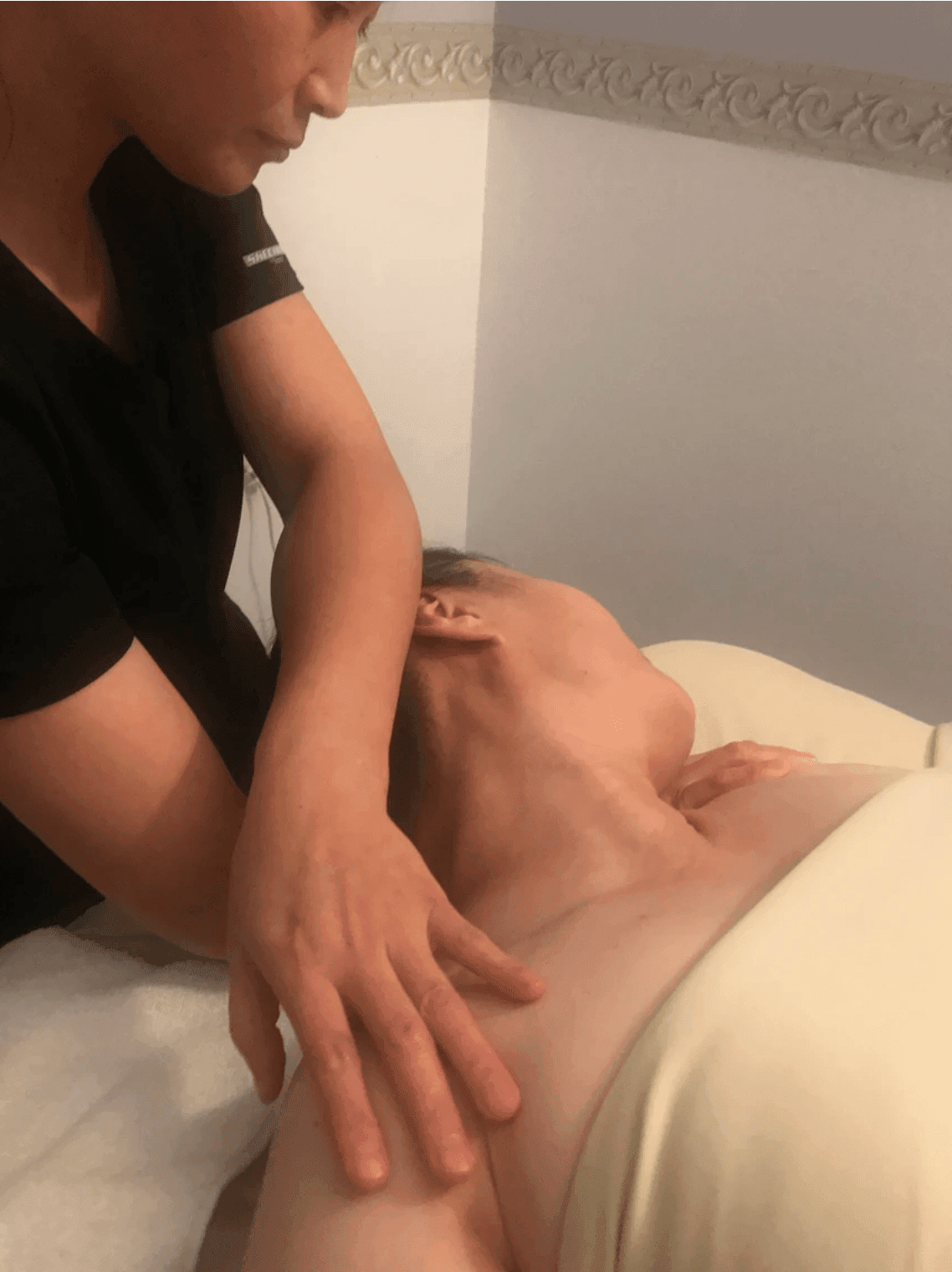
If you can’t fasten a bra strap, reach the top shelf, or sleep on your side without a sharp catch, you’re not imagining it — and you don’t need to live with it for twelve to eighteen months. Here’s exactly what a frozen shoulder session looks like at Relax Myora, so the only surprise is how little you tense up on the table.
First, is it actually a frozen shoulder?
Adhesive capsulitis — the clinical name — is a shrinking and thickening of the connective tissue envelope around your shoulder joint. The capsule becomes stiff and inflamed, which is why the hallmark sign is loss of motion in every direction, not just one. If you can shrug but can’t rotate your palm up, or you can reach forward but not behind your back, that pattern points away from a simple rotator-cuff strain.
A few other clues clinicians look for:
- Onset is slow. Pain crept up over weeks, not after a fall.
- Night pain that wakes you when you roll onto that side.
- Age 40–60, more common in women, and more common after shoulder surgery, a long sling period, diabetes, or thyroid issues.
- Passive motion is limited too. If your therapist lifts your arm for you and it still won’t go, that’s capsule-limited, not muscle-limited.
Before you book: if your pain started after an injury, you feel numbness or weakness down the arm, or you’ve never had the shoulder evaluated, see your physician first. Massage complements imaging, physical therapy, and sometimes an injection — it’s not a substitute for the work-up.
Stage one, two, or three — your session depends on which
Frozen shoulder moves through three stages, and the massage changes based on where you are. Your therapist will ask about pain patterns, sleep, and what you can and can’t do to figure out which stage you’re in.
| Stage | Timeline | What it feels like | What the session focuses on |
|---|---|---|---|
| Freezing | Weeks to months | Sharp, protective pain. Night pain. You guard the arm. | Pain modulation. Gentle fascial work on upper trap, levator scap, and pec minor to unload the joint. No forced stretching. |
| Frozen | Months, sometimes a year+ | Pain eases, stiffness takes over. Dressing, driving, and reaching back become the main complaints. | Deeper capsular work, cross-fiber on the subscap and infraspinatus, assisted mobility within tolerance. |
| Thawing | Months to a year | Range slowly returns. Lingering end-range stiffness and residual aches. | Longer-held myofascial stretches, home mobility progressions, scar-tissue remodeling across the capsule. |
Minute by minute: what a 90-minute first visit looks like
Our standard first visit for shoulder work is a 90-minute Hallmark Massage, because mapping the shoulder takes real time and you don’t want to pay to be rushed into it.
0:00–0:10 · Intake and movement screen
Your therapist will have you flex forward, abduct, reach behind your back (hand-to-pocket, then hand-to-opposite-shoulder-blade), and rotate the palm up with your elbow at your side. They’re measuring, roughly, how many degrees you’ve lost in each direction and where the sharp catch lives. Expect two or three movements you weren’t expecting — the trick is finding which range is most limited.
0:10–0:25 · Warming the surrounding tissue
Face-down, you’ll feel broad, slow strokes across the mid-back, upper trap, and the side of the neck. Nothing specific yet. The goal is to drop the baseline guarding so the shoulder girdle will actually move when you ask it to. Many clients drift off here. That’s fine — tell your therapist if the pressure is light enough that you lose track of the arm being worked on.
0:25–0:55 · The shoulder itself
Now the work gets specific. Side-lying is often more comfortable than face-down for frozen-shoulder sessions because it lets the therapist get at the subscapularis (the big internal rotator buried on the underside of the shoulder blade). Expect:
- Cross-fiber friction at the infraspinatus and teres minor insertion points — this feels like a firm, dull ache, not a sharp pain.
- Pin-and-stretch: your therapist holds a tight band of tissue while slowly moving the arm into gentle external rotation.
- Trigger-point release in the upper trap and levator scap, which are usually overworked from guarding the shoulder.
0:55–1:15 · Pec minor and anterior chest
Face-up now. If the chest wall is tight, nothing you do to the back of the shoulder will hold. Our therapists spend real time on pec minor — the small muscle under pec major — because it directly tilts the shoulder blade forward and keeps you looking rounded. You’ll feel focused pressure just below the collarbone and along the front of the armpit.
1:15–1:30 · Mobility work and a home prescription
The last fifteen minutes are the easiest to skip and the most important to keep. Your therapist will guide you through two or three small mobility drills — pendulums, towel slides along a wall, external rotation with a resistance band — and then write them down for you. The ones you do every day between sessions decide whether you keep what you gained.
Pain level — what to expect and what to tell your therapist
Working on a frozen shoulder is a conversation. You should feel firm pressure, a steady ache, and a pulling or stretching sensation at end range. You should not feel:
- Sharp or shooting pain
- Pins and needles down the arm
- The need to hold your breath to tolerate the technique
- Pain above a 6/10 that doesn’t ease when the pressure comes off
Any of those, speak up. Our therapists will modify immediately — a different angle, less depth, warmth first, or dropping that technique altogether. Massage therapy only works when you can stay in the parasympathetic (rest-and-digest) range; fighting the pressure defeats the point.
The 24 hours after your session
Plan for a quiet evening. Most clients feel looser immediately but a little tender for twelve to twenty-four hours — think of it like a workout for tissues that haven’t moved much in months.
What helps most, in order:
1. Drink an extra 24–32 oz of water that evening.
2. Do the mobility drills twice — once that night, once the next morning — gently, within pain-free range.
3. A warm (not hot) shower before bed.
4. Sleep on the opposite side with a pillow hugging the sore arm.
Skip: heavy lifting, overhead carrying, and ice directly on the joint for the first six hours.
How often, how long
Most clients benefit from a weekly 60- or 90-minute session for four to six weeks, then taper to every two or three weeks as range of motion improves. If you’re in the frozen or thawing stage, this is where our membership becomes the most practical option — one monthly session, member pricing on the rest, and credits that roll over if the week gets away from you.
Frisco or Allen — same technique, slightly different flow
Frisco
5285 Independence Pkwy, Suite 100
Frisco, TX 75035
214-407-7314
Easier parking, slightly larger treatment rooms — good if side-lying positioning matters.
Allen
190 E Stacy Rd, #1518
Allen, TX 75002
469-891-9938
Closer for Allen, Fairview, McKinney and Lucas residents. Infrared sauna on-site for pre-session warming.
Frequently asked questions
Most clients book 60 or 90 minutes. We recommend 90 minutes for the first visit so your therapist has time to map which movements trigger pain before working the shoulder itself.
You should feel firm pressure and a steady ache, not sharp or shooting pain. Our therapists work within your tolerance and modify immediately if you flinch, hold your breath, or report pain above a 6/10.
Most clients notice easier sleep and dressing within two to three sessions. Measurable range-of-motion gains typically appear in four to six weekly sessions when paired with the home mobility work your therapist gives you.
If the shoulder has not been imaged and the pain started suddenly, from a fall, or with numbness down the arm, see your physician first to rule out a rotator-cuff tear, labral injury, or cervical issue. Massage complements but does not replace that work-up.
Yes. Many clients book a 20-minute infrared sauna session before their massage — the heat warms the joint capsule and lets the therapist access deeper tissue sooner.
In most cases yes, with a letter of medical necessity from your physician. We accept FSA and HSA debit cards at the front desk at both locations.
Book your frozen shoulder session
Our therapists see this condition weekly. First visits are 90 minutes so we can do it properly.